TEST PLANNING
What is Test Planning?
Test Planning is a collaborative planning process, streamlined to identify, understand, and tackle significant spatial conflicts, challenges, and opportunities. It’s a legally non-binding instrument that serves an advisory function, designed to work effectively in dynamic contexts and situations of high uncertainty.
Planning professionals, political decision-makers, investors, interest groups, and locals all take part, testing and evaluating different strategies together through the participative interplay of design and dialogue. This approach doesn’t just generate innovative ideas. It can also secure political consent, which in turn gives the planning process legitimacy and makes its goals more achievable.
How It Works?
- Several project teams work in parallel, developing their proposals from the same starting data and under equal conditions. No single winner is declared.
- The process is built around workshops and mid-term reviews. At each stage, the work is refined and evolves in response to feedback and new questions that emerge along the way.
- A Guiding Committee follows the process throughout, reviewing proposals, raising critical questions, and ultimately helping bring the strongest elements together into a single final vision.
- This final vision is the process’s strategic outcome — providing a clear basis for updating planning documentation and defining next steps.
Why Test Planning?
Lviv North needs a method suited to Ukraine’s current planning context – one shaped by ongoing reforms and the demands of war, where cities must respond to urgent needs while also laying the groundwork for long-term, sustainable recovery.
Test Planning provides a framework for working systematically under these conditions and building a shared vision for the area’s development.
Works under uncertainty
War and ongoing reforms call for a planning approach that can adapt without losing direction.
Links individual projects to strategy
Helps align separate initiatives within one shared vision for the district’s development.
Supports coordination
Creates a common framework where formal decisions can be brought in line with real needs and conditions on the ground.
Phases and Timeline
Test planning follows a three-stage structure. It starts with preparation, moves into the core workshop cycle, and ends with a stage of alignment and consolidation. Each stage has a clear goal and builds on the results of the one before it.
1
Preparation
In this stage, the city and organizers define the area’s boundaries and key issues, prepare base maps and source materials, and set shared ground rules for all teams. This ensures every participant starts from the same brief and the same set of data.
2
Implementation
This is the core stage of the project work. Five teams develop their alternative proposals in parallel, through workshops and mid-term reviews. Each round makes it possible to test different scenarios and priorities, gradually shaping a more coherent spatial framework that accounts for all aspects of urban planning.
3
Consolidation
In the final stage, the strongest elements of 5 alternative proposals are brought together into a single vision and a package of recommendations with clearly defined priorities and next steps. Going forward, these results are meant to form the basis for updating planning documentation and carrying out subsequent projects.

Workshops
Most of the work takes place during the Implementation phase, across three workshops. Each one plays its own role in the process – from an initial reading of the area to shaping full proposals and drawing conclusions.
Understand the area and set the direction. This stage builds a shared understanding of North Lviv. Teams review the base materials, visit the site, identify the main challenges and opportunities, and outline initial strategic directions to develop further.
Develop and test comprehensive proposals. Teams move toward more integrated spatial solutions, focusing on how key elements interact – development structure, mobility, public space, and the blue-green network. This stage also tests how realistic the solutions are and sets priorities ahead of the final workshop.
Compare, refine, and consolidate. Teams present their final proposals for joint review and comparison, and at the end of the workshop cycle, all five teams’ results are presented publicly.
Institutional Structure
The process is carried out in partnership with the cities of Lviv and Zurich, the Canton of Zurich, Swiss Network with Ukraine, Studio Zmist and ONPlan lab
-
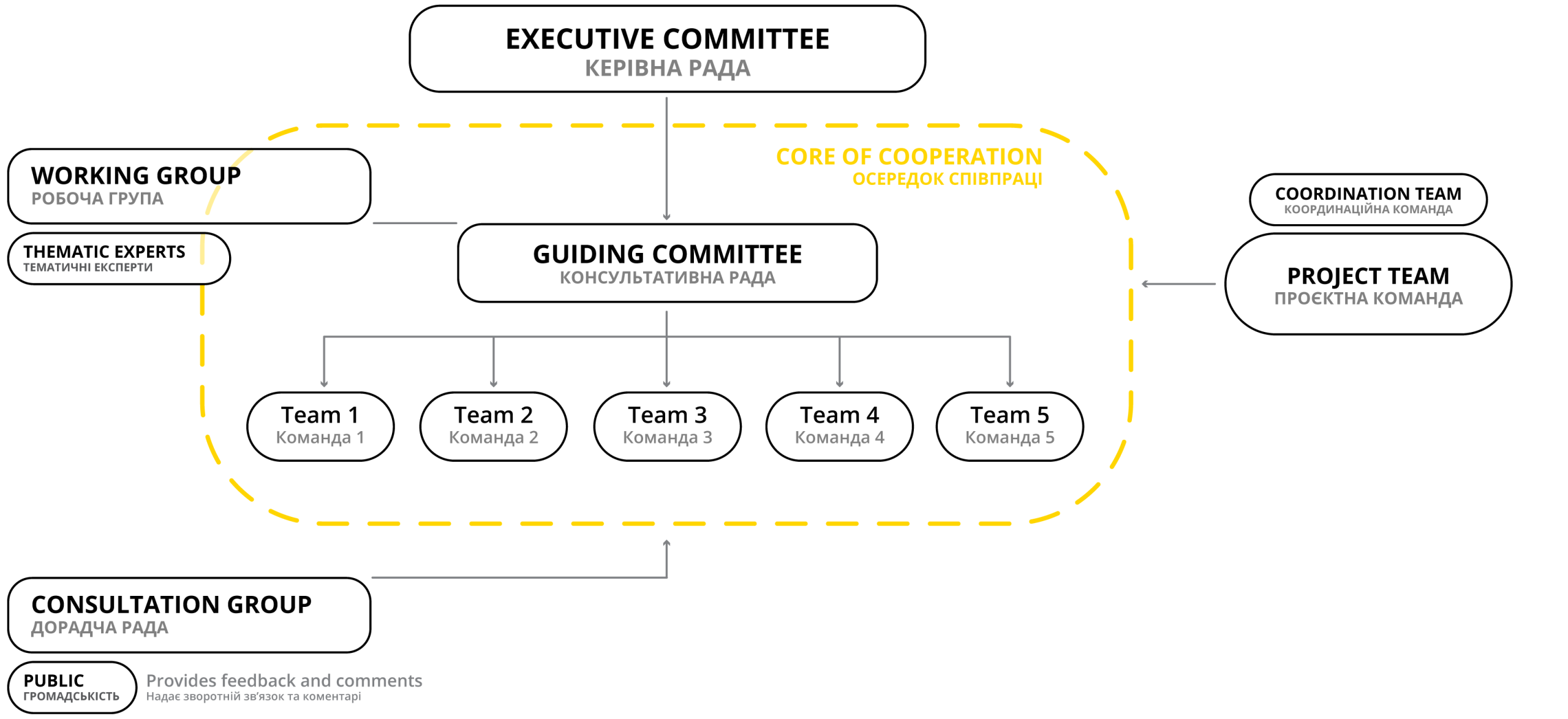
The Executive Committee is the formal decision-making body. It steers the test planning process and approves its key stages. The Executive Committee doesn’t take part directly in the design phase – it delegates day-to-day work to the coordination team and other participants.
Executive Committee
- Andriy Sadovyi — Mayor of Lviv
- Andriy Moskalenko — First Deputy Mayor, Deputy Mayor for Economic Development, and Acting Deputy Mayor for Housing and Communal Services
- Iryna Kulynych — Deputy Mayor for Humanitarian Affairs
- Yevhen Boiko — Head of the Executive Committee
- Iryna Marunyak — Deputy Mayor for Accessibility
- Lyubomyr Zubach — Deputy Mayor for Urban Planning
- Representative of the “European Solidarity” faction
- Representative of the “Samopomich Union” faction
- Representative of the “Varta” faction
- Representative of the “Holos” faction
- Representative of the “All-Ukrainian Union ‘Svoboda'” faction
-
The Guiding Committee moderates the process and supports the planning teams throughout the active phases of test planning. It’s led by an appointed moderator and puts together a joint recommendation for the Executive Committee once the process wraps up. Planning teams interact with the Guiding Committee during workshops and review phases.
Guiding Committee
- Anton Kolomieitsev — Chief Architect of Lviv, Director of the Department of Architecture and Urban Planning. Represents the City of Lviv and ensures the Test Planning process is integrated into the city’s broader planning system.
- Oleksandr Kobzariev — Executive Director, “UNBROKEN” Charitable Foundation, Lviv.
- Oleh Zabarylo — Director of the Department of Urban Mobility and Street Infrastructure, Lviv City Council.
- Taras Kubai — Director of the Department of Natural Resources and Construction, Urban Planning Office of Lviv City Council; has coordinated modular temporary housing projects.
- Kees Christiaanse — architect and urbanist, founder of KCAP. President of the Swiss Network with Ukraine. Provides overall leadership and strategic direction for the Test Planning process.
- Katrin Gügler — Director of the Zurich Office for Urban Development, with extensive experience in urban development and high-quality strategic planning in Swiss cities.
- Johannes Tovatt — Swedish architect and urbanist, Creative Director at Tovatt Architects & Planners (part of Sweco), and lead designer of the Seestadt Aspern urban development project in Vienna.
- Monika Konrad — architect and urbanist with experience across Europe and Asia, Associate Professor at the Brno University of Technology, and Deputy Director of the Department of Architecture and Spatial Planning for the City of Warsaw.
- Martin Arfalk — founder of Mandaworks, an urban design and landscape architecture firm based in Malmö, Sweden.
- Burkhard Horn — expert in urban mobility and transport planning, former head of the Transport Department of the Berlin Senate, now an independent consultant.
- Yurii Stoliarov — Chief Architect at “Mistoproekt” SE, known for his conceptual planning projects in Lviv.
- Ihor Mohyla — Doctor of Technical Sciences, expert in urban mobility, sustainable transport, and road safety, with over a decade of experience working in Ukraine.
-
The Coordination Team handles the day-to-day coordination and content management of the process, ensuring communication between the municipality, international experts, planning teams, and other participants. Together with the city, it develops the program for the process, defines the deliverables expected from the planning teams, and helps shape the vision for how the process moves forward. The Coordination Team is also responsible for the public communication of the process – one of the core principles of test planning – alongside preparing source materials and organizing workshops and participatory events.
Coordination Team
- Franziska Matt — representative of the City of Zurich. Lead consultant on the Swiss side, with expertise in the Test Planning methodology, and coordinates the connection with Zurich’s institutional framework.
- Urs Thomann — practitioner and consultant in spatial planning and urban development, with many years of experience in planning processes in Ukraine. Provides methodological support and liaises with the Swiss Network with Ukraine.
- Iris Gleichmann — urbanist and consultant with strong familiarity with the Lviv context. Founder of the Gleichmann Urban Management Office. Supports the process with contextual expertise and helps bridge local and international perspectives.
- Yegor Vlasenko — researcher at EPFL, coordinator within the Swiss Network with Ukraine. Supports organizational and academic ties between Switzerland and Ukraine.
- Daniel Kiss — architect, XM Architekten (Zurich). Supports international coordination and the exchange of planning expertise.
- Maryna Peleshchak — Head of the Strategic Planning Sector, Department of Architecture and Spatial Development, representing Lviv City Council. Handles communication with city departments and stakeholders.
- Petr Návrat — Member of the Royal Town Planning Institute, a leading expert in urban regeneration and public participation in the Czech Republic, Managing Partner at ONplan, and moderator of the Lviv North Test Planning process.
- Alex Yeloyeva — urbanist, junior planner at ONplan. Supports the process through analytical input and material structuring.
- Markiian Maksymiuk — project lead and CEO of Studio Zmist. Developed the brief for the Design Teams and leads the Coordination Team — overseeing the process, content, communication, workshops, stakeholder engagement, and the public exhibition.
- Valeriia Debretseni — project manager, Studio Zmist. Assisted in developing the brief for the participating Design Teams and supports coordination, communication, workshops, stakeholder engagement, and the public exhibition.
-
The Design Teams develop visions for the test planning territory. Each planning team brings together expertise from both Ukrainian and international specialists.
Склад планувальних команд
Five interdisciplinary teams are working on the Lviv North Test Planning process. Each brings together Ukrainian and international expertise, pairing deep knowledge of the local context with planning approaches and practices from abroad. This format encourages knowledge exchange, methodological diversity, and international collaboration.
Team 1

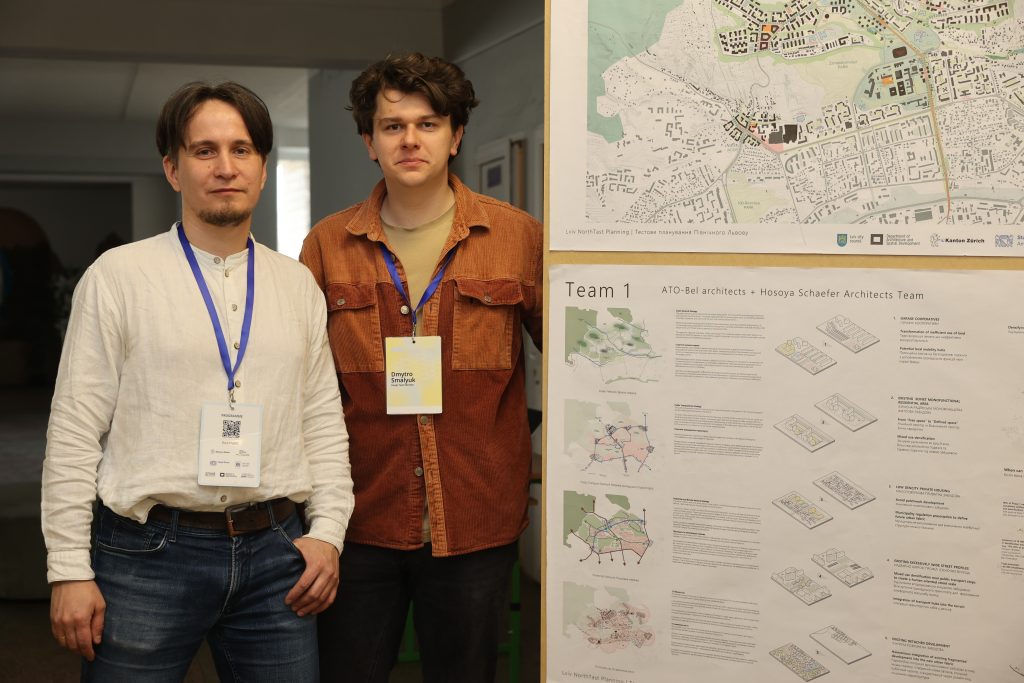
Hosoya Schaefer Architects + ATO-Bel Architects
Hosoya Schaefer Architects is a Zurich-based studio working across architecture, urban design, and research. Founded by Markus Schaefer and Hiromi Hosoya in 2003, the firm is known for its innovative approach, spanning building design and construction, urban design, and media installations. It has received numerous international awards and worked on a wide range of projects, including major new urban districts such as HafenCity Elbbrücken and Wilhelmsburg Elbinsel in Hamburg, Germany. In Switzerland, the team has won awards for Engadin Airport near St. Moritz, a railway station and square in Herisau, and the transformation of the MEWA-Areal site in Wädenswil.
ATO-Bel Architects is a Ukrainian architecture studio whose practice draws on the principles of Christopher Alexander, prioritizing structure, human scale, and the long-term functionality of space. ATO-Bel has won a number of architectural competitions and received the Ukrainian Urban Awards in 2018. Their portfolio includes the Villa Magnolia residential complex and a winning entry in the competition for a rehabilitation center in Briukhovychi.
Team members:
- Markus Schaefer
- Alexander Kneer
- Taras Byelyayev
- Andrij Byelyayev
- Dmytro Smalyuk
- Nataliia Mysak
Team 2



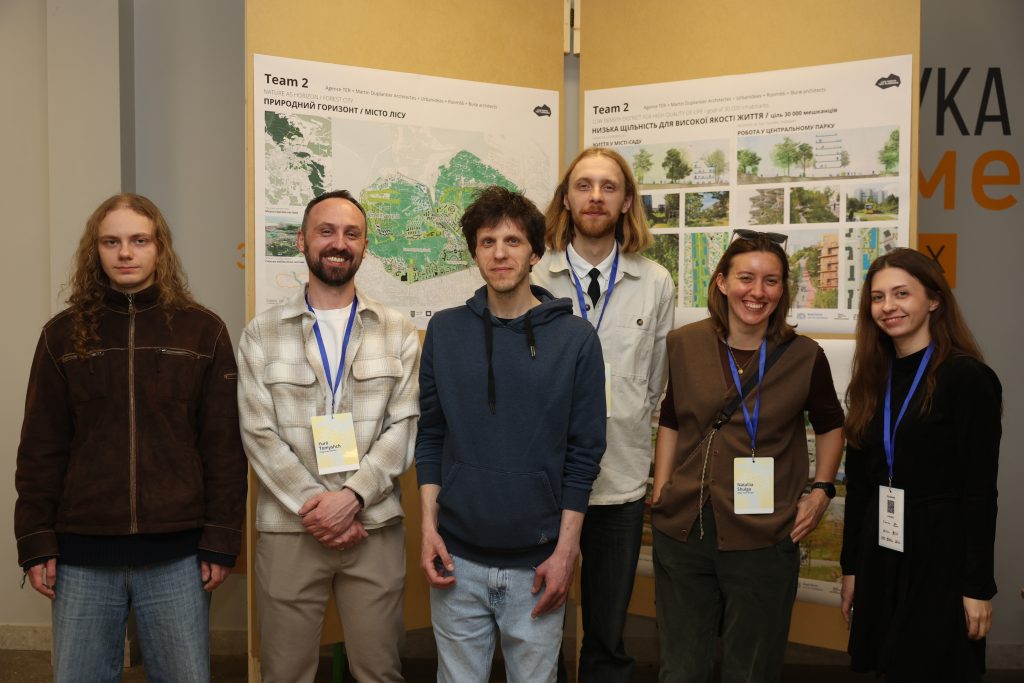
Agence TER + Martin Duplantier Architectes + Burø + URBANIDEAS + Room 66 Studio
Agence TER is a leading international landscape architecture and urban design firm, active in France, Germany, China, and Spain. Its approach to city planning centers on supporting climate, ecosystems, and territories, while building a sense of collective identity. The studio has earned international recognition – including the prestigious Grand Prix de l’Urbanisme (2018), the Prix Magnolia (2022), and The Plan Award (2024) – for its ability to bring nature back into cities, through large-scale projects like the Metropolitan Park of Saint-Ouen in France, Shanghai’s 21km waterfront, Zac des 2 Rives in Strasbourg, and the 2024 Paris Olympic Village.
Martin Duplantier Architectes is a French studio working across three interconnected fields – landscape design, urban planning, and architecture – combining them into complementary strategies for creating people-centered spaces. In 2022, MDA opened an office in Lviv to take part in projects supporting Ukraine’s reconstruction. Its portfolio includes educational facilities like HEC student housing and the Aqueduc campus, along with infrastructure and urban projects such as the Mobility Centre for the 2024 Paris Olympics, the Promenade des Sources in Anglet, France, and the Alzette-Micheville revitalization project in Esch-sur-Alzette, Luxembourg.
Burø is a Kyiv-based team specializing in public space design, housing, and civic buildings, as well as territorial master planning. Among their notable works is the revitalization concept for Rybalskyi Island in Kyiv.
URBANIDEAS is a Lviv-based studio working across scales, from concept design to spatial planning strategy, blending cultural and social context with a sense of place and time. The team has won numerous architectural competitions, and their redesign of Koliivshchyny Square in Lviv was featured in Contemporary Landscape Architecture: Masterpieces Around the World.
Room 66 Studio is a Lviv-based architecture and design studio focused on creating cohesive, comfortable environments that are functional, aesthetic, contextual, and inclusive.
Team members:
- Henri Bava
- Charlotte Beau Yon De Jonaje
- Naja Herforthtokkesdal
- Martin Duplantier
- Andrii Shtendera
- Anton Kuzmin
- Oryna Tokar
- Nataliia Shulga
- Ola Kryvoruchko
- Valentyn Sharovatov
- Yurii Tomyshch
- Olena Komarenets
Team 3


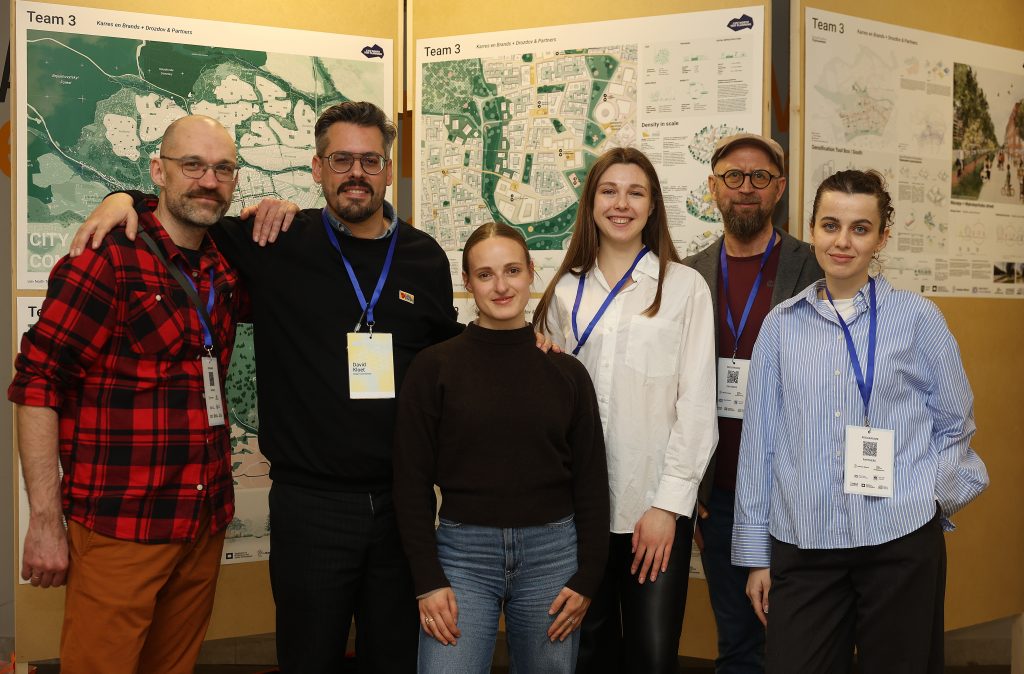
Karres en Brands + Drozdov & Partners
Karres en Brands is a Dutch multidisciplinary design studio. The team develops smart, considered responses to contemporary challenges, creating resilient, flexible, and grounded spatial concepts that give places a timeless, recognizable identity. The studio has earned wide acclaim for its Oberbillwerder master plan in Hamburg, which won several awards, including “Future Project of the Year” at the World Architecture Festival (WAF) 2019 and The Plan Award 2020. Other notable projects include the Hart van Zuid development in Rotterdam and the WoodHood master plan in Cologne, Germany.
Drozdov & Partners is one of Ukraine’s leading architecture studios. Originally founded in Kharkiv, the team is now based in Lviv, led by Oleg Drozdov, co-founder of the Kharkiv School of Architecture — the country’s first private architecture school. The studio is known for its deep understanding of urban context, a distinctive design style, and extensive built experience. Its portfolio spans both Ukrainian and international projects, often involving complex interventions in the urban fabric. The team has received the EE Real Estate Project Award and Ukrainian Urban Awards, and was nominated for the Mies van der Rohe Award. Notable works include the Unbroken social housing project on Mykolaichuka Street in Lviv and the Podil Theatre in Kyiv.
Team members:
- David Kloet
- Leana Hahn
- Alzbeta Gazdova
- Ewa Abratkiewicz
- Julia Kniess
- Oleg Drozdov
- Maksym Shulha
- Anastasiia Yakovets
- Mariia Shkolnyk
Team 4


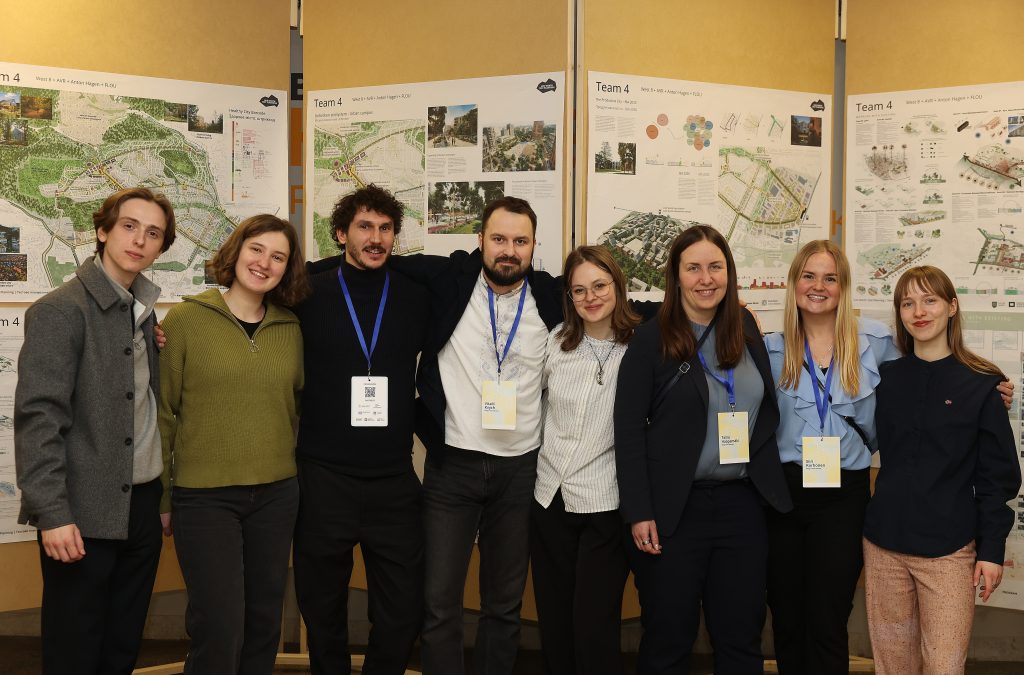
West 8+ AVR Development
West 8 is a forward-thinking Dutch firm with studios across Europe and North America. For more than 35 years, the team has been reshaping landscape architecture, urban design, and sustainable planning, creating meaningful spaces built on the concept of “second nature.” This pioneering approach has taken shape in landmark projects around the world, including Eastern Docklands in Amsterdam, Jubilee Gardens in London, Madrid RIO, Governors Island in New York, and Yongsan Park in Seoul. West 8 has received numerous awards, among them the Global Award for Sustainable Architecture, the American Society of Landscape Architects (ASLA) Award, and the International Urban Landscape Gold Award (IULA).
AVR Development is one of Ukraine’s largest and most experienced architecture firms, working across urban planning, architecture, and engineering – from large-scale concept design through full project delivery. Led by Yulian Chaplinsky, former Chief Architect of Lviv, the studio combines strategic thinking about urban space with a deep understanding of the practical realities of Ukrainian city planning. AVR Development has been nominated for major awards including the Ukrainian Urban Awards, Polish Urban Awards, Mies van der Rohe Award, and REM Awards. Its landmark projects include the revitalization of the Jam Factory Art Center, Lem Station, and KIVSH, as well as the Viking Park residential complex in Lviv.
Team members:
- Martin Biewenga
- Nazar Dutko
- Emanuele Paladin
- Vitalii Kvych
- Iryna Herts
- Kseniia Bevziuk
- Daniel Fanta
- Anastasiia Sytnyk
- Daria Tereshchenko
- Taina Haapamäki
- Siiri Korhonen
Team 5

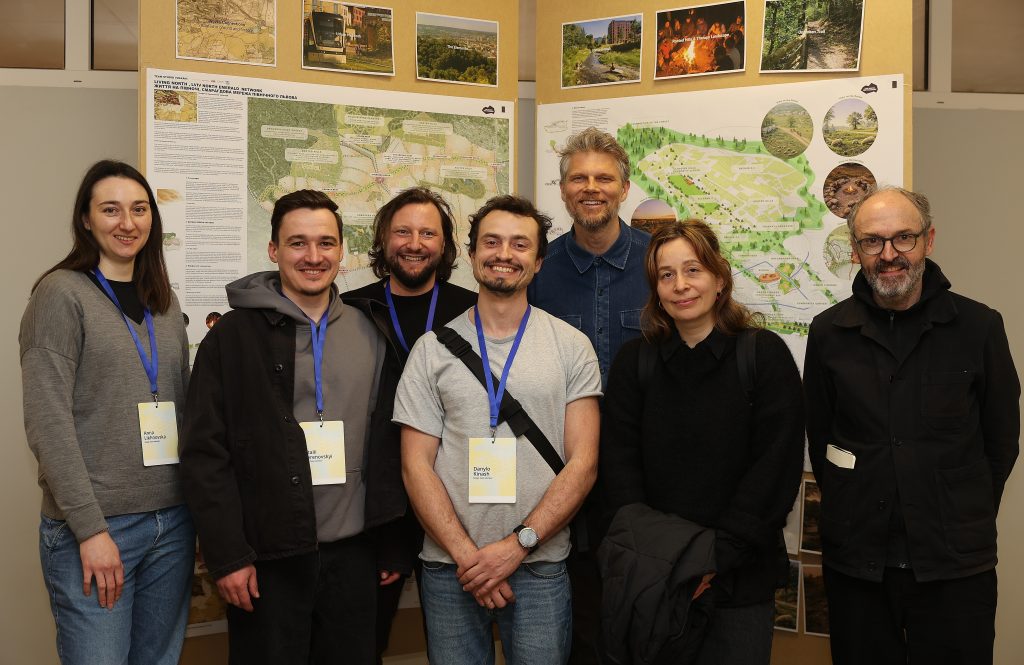
Studio Vulkan + ABMK
Studio Vulkan, founded in Zurich in 2014, specializes in landscape architecture and expanded internationally as early as 2016 with the opening of a Munich office. The studio treats open space as essential infrastructure, applying network thinking to integrate natural, social, and climate systems across every scale – from urban design down to furniture. The team has received numerous awards, including the Landezine International Landscape Award (LILA) Office Award (2019), along with individual LILA project awards in 2021 and 2023. Notable works include the rooftop gardens at Toni Areal, Butzenbüel Park at Zurich Airport, and the Fil Bleu Glatt riverside development strategy in Zurich.
ABMK is one of Ukraine’s largest architecture studios, bringing together specialists across disciplines around principles of architectural integrity, engineering rationality, and environmental sustainability. ABMK has developed several projects for the UNBROKEN ecosystem, including its flagship rehabilitation center, nominated for the Mies van der Rohe Award 2026. Other notable projects include the reconstruction of the Enzym factory, the Formatsiia industrial park in Lviv, and the reconstruction of the Ukrainian Catholic University building on Sventsitskoho Street.
Team members
- Lukas Schweingruber
- Ursa Habic
- Luz Saldutti
- Sonja Rozman
- Nichin Tsai
- Chen Tsung-Wen
- Danylo Kinash
- Anna Likhnovska
- Vitalii Derenovsky
- Petter Grimm
- Simon Enemærke
- Haakon Askim Vatne
- Silvan Nigg
- Elias Staudinger
- Anna Minor
- Mauro Jutz
Yaroslav Shkabura